Rattan Pendant Lights: How to Choose Size, Shape & Weave
- The Short Answer
- What Actually Determines Whether a Rattan Pendant Works
- Choosing by Weave Pattern
- Choosing a Shape for Your Space
- Sizing Before You Buy
- Wiring, Hardware, and Bulb Choice
- Price Ranges: What You're Actually Paying For
- Rattan vs. Other Woven Materials
- Where Rattan Pendants Fit Best, Room by Room
- Buying Checklist
The Short Answer
A good rattan pendant comes down to three decisions: weave density (how much light it lets through), shape (how that light gets thrown around the room), and hardware (whether it's actually safe to wire in). Open, wide weaves make the best ambient or accent light and read more casual; tight basket or herringbone weaves throw a warmer, more directional glow and suit dining tables and kitchen islands where you want less glare at eye level. Get the size right before either — a pendant that's too small for its table or island will look like an afterthought no matter how well it's woven.
What Actually Determines Whether a Rattan Pendant Works
Rattan pendants get judged on the same three criteria whether you're looking at a budget import in the double digits or a workshop piece several hundred dollars up:
- Weave density and openness — how tightly the rattan poles or peel are woven, and how much gap is left between them. Bulb output and beam angle still set how bright the room is; within the shade itself, this is the biggest variable in how the light lands.
- Shape and light throw — dome, drum, cone, and globe shapes each scatter light differently, and each suits different table and ceiling proportions.
- Frame and hardware quality — the metal ring or wood frame the weave is built around, plus the socket, cord, and mounting hardware, which determine whether the shade holds its form and whether the wiring meets basic safety standards.
Price mostly tracks the third criterion. Two pendants can look nearly identical in weave and shape and still differ by a hundred dollars or more because one has a socket and cord that have actually been tested against a safety standard and the other doesn't.
It's worth being precise about the markings here, because the two you'll see most often are not equivalent. A UL or ETL listing means an independent testing laboratory — a Nationally Recognized Testing Laboratory, in US regulatory terms — tested the component and certified it, and the listing can be looked up in that lab's public directory. A CE mark is not a listing at all. For most lighting products the manufacturer applies it themselves as a self-declaration that the product conforms to EU requirements; no third party has to test anything. Self-applied and counterfeit CE marks are common on inexpensive imported fixtures, which is exactly the end of the market this section is warning you about. Treat UL or ETL as evidence, and treat a CE mark as a claim worth confirming with the retailer.
Choosing by Weave Pattern
Open or Wide Weave
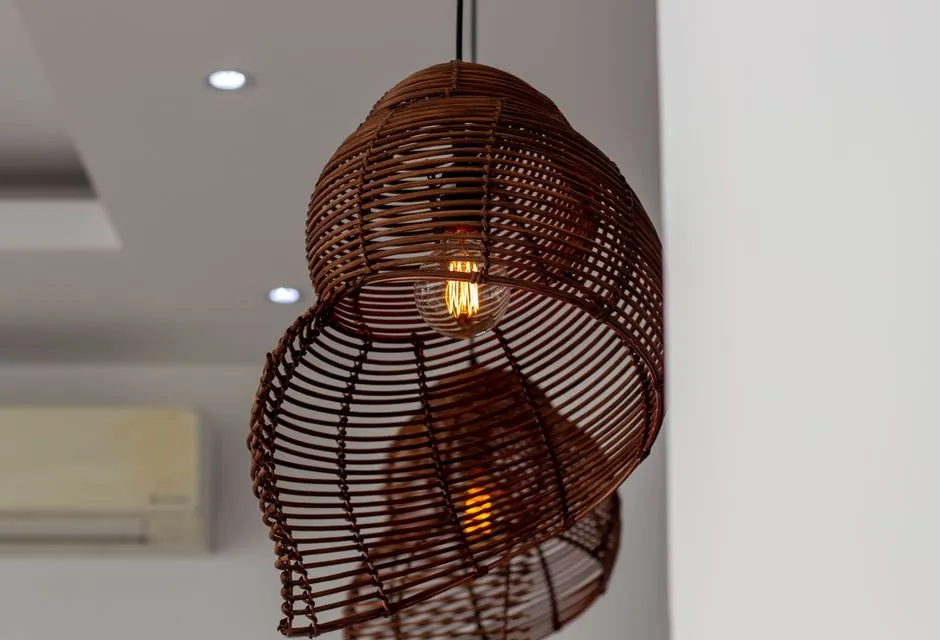
Wide, loosely spaced weaves — sometimes called "basket" or "cage" weaves depending on the shop — leave visible gaps between the rattan strands. Light spills through in a dappled, dotted pattern across the ceiling and walls.
Why it works: This is the pattern most people picture when they think of a rattan pendant, and it's genuinely good at ambient, mood-setting light. It also tends to be the more affordable end of the category, since less material and labor go into the weave itself.
Worth knowing: An open weave puts the bare bulb in view more than a tight one does. If you don't like seeing a glowing filament or LED bulb through the gaps, you'll want a frosted or vintage-style bulb inside, not a clear one.
Tight Basket or Herringbone Weave
Here the rattan is woven close enough that individual strands nearly touch, sometimes in a herringbone or diagonal pattern rather than a simple over-under.
Why it works: Tighter weaves diffuse light more evenly and cut glare, which is exactly what you want directly over a dining table or kitchen island where people are sitting or working underneath. The shade itself also reads a bit more refined and less rustic than a wide-open weave.
Worth knowing: Tighter weaves take more skill and material to produce, so they sit at the higher end of the price range for a given size. They can also run slightly dimmer as ambient light sources since less light escapes sideways — plan on them as task or accent light over a specific surface, not as a room's only light source.
Structured or Geometric Weave
Some rattan pendants use a more architectural pattern — hexagonal lattice, chevron, or a repeating geometric motif — built over a rigid frame rather than a free-form basket shape.
Why it works: These read more contemporary and pair well in a room that's mixing Southeast Asian materials with a more modern or minimalist palette rather than going fully rustic.
Worth knowing: The rigid frame usually means less flexibility in the finished shape, and repairs are harder if a strand breaks, since the pattern is engineered rather than hand-adjusted. If having it in the same room as more traditional rattan furniture matters to your look, check that the tones of the material actually match — a bleached, structured pendant next to a natural, honey-toned rattan chair can look mismatched.
Choosing a Shape for Your Space
Shape affects light throw as much as weave does, and it's the part most buyers skip past to get to color and price. The diameters below are starting bands drawn from standard pendant sizing rather than product-specific specs — check them against your own measurements before ordering.
| Shape | Light throw | Best over | Typical single-fixture diameter | Worth knowing |
|---|---|---|---|---|
| Dome | Downward-focused, some upward spill through the weave | Dining tables, reading nooks | 20–24" over tables to about 48" wide; 24–30" for longer tables | Reads heavy at large diameters — check ceiling height before sizing up |
| Drum | Even, diffused in most directions | Kitchen islands, entryways | 12–16" as a single over an island up to about 36"; 8–12" each in a pair | Needs a tighter weave to avoid a "hollow" look from below |
| Cone | Strongly downward, more like a spotlight | Task areas, small breakfast bars | 8–14" in most task positions | Casts a narrow pool of light, so it works as one layer rather than a room's only source |
| Globe/lantern | Light scatters in nearly all directions | Living rooms, bedrooms, multi-pendant clusters | 12–20", scaled to the room or surface rather than a table width | Brightest-reading option but shows more of the bulb itself |
None of these shapes is objectively "better" — they're suited to different jobs. A cone that's perfect focused light over a reading chair would be a poor single light source for an open kitchen.
Sizing Before You Buy
Weave and shape only matter if the pendant is the right size for the space. As a rough starting point, many designers size a single dining pendant to roughly one-third to one-half of the table's width, then set the hanging height by what's underneath: commonly 30 to 36 inches from tabletop to the bottom of the shade over a dining table, and a slightly lower 28 to 34 inches over a kitchen counter, where you're standing rather than seated. Adjust upward for tall ceilings. For islands, the more common approach is two or three smaller pendants spaced evenly rather than one large fixture.
Because exact sizing depends on ceiling height, table dimensions, and how many fixtures you're hanging, it's worth working from a proper pendant sizing chart rather than guessing. Our editorial view, for what it's worth: undersizing is the easiest mistake to make in this category and the hardest to live with once the fixture is hung and wired. Woven shades in particular read smaller than their measured diameter suggests, because the open pattern breaks up the silhouette — if you're between two sizes, the larger one is usually the safer bet.
Wiring, Hardware, and Bulb Choice
The weave is the part you see; the wiring is the part that matters for safety. A few things worth checking before you buy, especially with imported fixtures:
- Independently tested hardware. A UL or ETL mark on the socket and cord means a third-party laboratory certified that component, and you can verify the listing in the lab's online directory. A CE mark is the manufacturer's own declaration of conformity, not proof that anyone outside the factory tested it — useful context, weak evidence on its own. If a fixture carries only a CE mark, ask the retailer whether the fixture has been safety-tested for your region and by whom. This matters more than almost any cosmetic detail.
- Cord and canopy length. Rattan pendants are often sold with a fixed cord length that may need to be shortened or extended by an electrician depending on your ceiling height — factor that into cost if you're not comfortable doing it yourself.
- Bulb temperature. Warm white bulbs, generally in the 2700K–3000K range, suit rattan's natural tones far better than cool daylight bulbs, which tend to make the material look washed out. Dimmable-rated sockets are worth the small premium if the fixture will double as ambient and task lighting.
- Weight and mounting. Larger woven shades are lighter than they look, but always confirm the mounting hardware is rated for the fixture's actual weight, not just its category average.
Price Ranges: What You're Actually Paying For
Rattan pendants span a wide range, and price mostly tracks weave complexity, frame material, and hardware quality rather than size alone. Small, open-weave single pendants from mass import retailers commonly run in the lower two figures to around $80–$100. Mid-range pieces with tighter weaves, solid wood frames, and listed hardware typically land somewhere in the $100–$250 range. Larger statement pieces, multi-light clusters, or workshop-made fixtures with more elaborate patterns can run well past that. Treat these as general bands, not fixed tags — availability and retailer markup vary, and it's worth pricing a specific fixture against a couple of comparable listings before deciding a price is fair.
If your budget skews toward the lower end, spend it on hardware quality over weave complexity — a simple, open weave with an independently listed socket is a better buy than an intricate weave with unverified wiring.
Rattan vs. Other Woven Materials
Rattan isn't the only woven option in this category, and it's not automatically the right one for every room. The most useful comparison is with bamboo, and the difference between them is structural rather than stylistic.
Rattan is a solid-cored climbing palm stem. Steamed, it bends into a curve and holds that curve permanently, which is why rattan shades can be continuous domes, globes, and rounded basket forms with no visible joins — the material itself does the shaping. Bamboo is a hollow, segmented grass: rigid along its length and inclined to split if you try to bend a full culm. Bamboo pendants are therefore usually built from split strips or short straight lengths lashed, pinned, or joined at angles, which produces the more linear, slatted, faceted look the material is known for. That construction difference also predicts how each one ages. A bamboo fixture tends to fail at its joins or lashings; a rattan shade more often loosens or goes slightly out of round at the frame it's woven over, which is easier to live with and sometimes easier to correct.
Finish behaves differently too. Rattan peel takes stain and bleach readily, so you'll find it in everything from bone-white to deep walnut tones. Bamboo's hard, silica-rich outer skin resists stain, so bamboo pieces are more often sold in their natural tone or heat-treated to a darker caramel. Bamboo also grows and is processed quickly, and often costs less at comparable sizes. Neither material is better — they photograph similarly and behave differently, and the choice usually comes down to whether you want curves or lines.
For a side-by-side on specific styles, see our guide to bamboo pendant lights. If you're furnishing the rest of the room in rattan or cane, our broader rattan furniture guide covers keeping tones and weave styles consistent between lighting and seating.
Where Rattan Pendants Fit Best, Room by Room
- Kitchen islands — favor tighter weaves and a drum or dome shape in a cluster of two or three, sized down from what you'd hang as a single dining pendant.
- Dining tables — a single dome or larger drum centered over the table, sized to the table width with adequate headroom for anyone standing to serve.
- Entryways — this is where a bolder open weave or lantern shape earns its keep, since it's more about first impression than even task light.
- Living rooms and bedrooms — globe or lantern shapes at lower wattage work well as supplementary ambient light rather than a room's sole source.
Buying Checklist
- Weave density chosen for the job the fixture has to do, not for the look alone.
- Shape matched to what's underneath it, using the table above.
- Diameter and hanging height checked against the sizing chart before anything else — including the tendency of woven shades to read small.
- Socket and cord: independent listing (UL or ETL) preferred; a CE mark alone confirmed with the retailer.
- Bulb warm rather than daylight, on a dimmable-rated socket if the fixture is doing double duty.
- Cord length and mounting weight rating confirmed against your own ceiling.
- Price judged against hardware and weave complexity rather than size.