Best Bamboo Pendant Lights: 7 Styles That Actually Last
- The short answer
- What separates a good bamboo pendant from a bad one?
- How do the seven bamboo pendant styles compare?
- Which bamboo pendant style suits which room?
- How do you read a bamboo pendant listing?
- What size bamboo pendant should you choose?
- What should you know before installation?
- How do you care for a bamboo pendant?
- Which style is the best final choice?
- Sources
The short answer
For most rooms, a woven bamboo bell or dome pendant gives the best mix of warm, patterned light and everyday durability. Choose an open-weave rib-cage pendant when dramatic shadow is the point, or a flared basket shade when you want a budget-friendly fixture that still looks deliberate. The best bamboo pendant light is therefore a shape-and-job match, not one universally superior product.
This guide compares seven recurring styles rather than pretending one shopping link can settle the matter. Construction quality varies within every style. Use the comparison for shape, light behavior and likely price, then use the listing decoder below to judge the actual fixture in front of you.
What separates a good bamboo pendant from a bad one?
Four things do most of the work:
- Weave and frame quality: tight, even spacing is a better sign than loose or irregular strips that may sag or gap.
- Light behavior: the amount of light that passes through matters, but so does where it goes and what shadows the weave casts.
- Build durability: look at how the frame is joined and whether the maker explains how the bamboo was dried and finished.
- Room fit: a lovely shade can still be wrong for the ceiling height, surface below it or other light sources in the room.
Those are the four criteria used throughout this comparison. They are also the four worth checking against close-up photos and specifications. Bamboo pendants generally run from budget mass-market pieces at roughly $20–$50 to better-finished mid-range pieces around $60–$150, with hand-woven or larger-format fixtures going higher. Prices move by retailer, region and size, so treat those figures as orientation rather than a current quote.
How do the seven bamboo pendant styles compare?
| Style | Best for | Light behavior | Rough price band |
|---|---|---|---|
| Woven bell/dome | Dining tables, entryways | Medium, warm glow | $40–$120 |
| Flared basket shade | Budget-friendly overhead light | Medium-high, spread wide | $20–$70 |
| Cylinder lantern | Hallways, bedside, small nooks | Low-medium, mostly sideways | $30–$90 |
| Open-weave rib cage | Statement pieces, kitchen islands | High, strong shadow pattern | $60–$180 |
| Bamboo-rattan hybrid drum | Living rooms, layered looks | Medium | $70–$160 |
| Cone/trumpet | Kitchen islands, task areas | Medium-high, downward-focused | $50–$130 |
| Globe/sphere | Bedrooms, softer ambient light | Low-medium, diffused | $50–$140 |
The table describes what the shade tends to do, not how bright the complete fixture will be. Bulb output, lining, weave density, room surfaces and other lights all change the result.
Which bamboo pendant style suits which room?
1. Woven bell or dome pendant
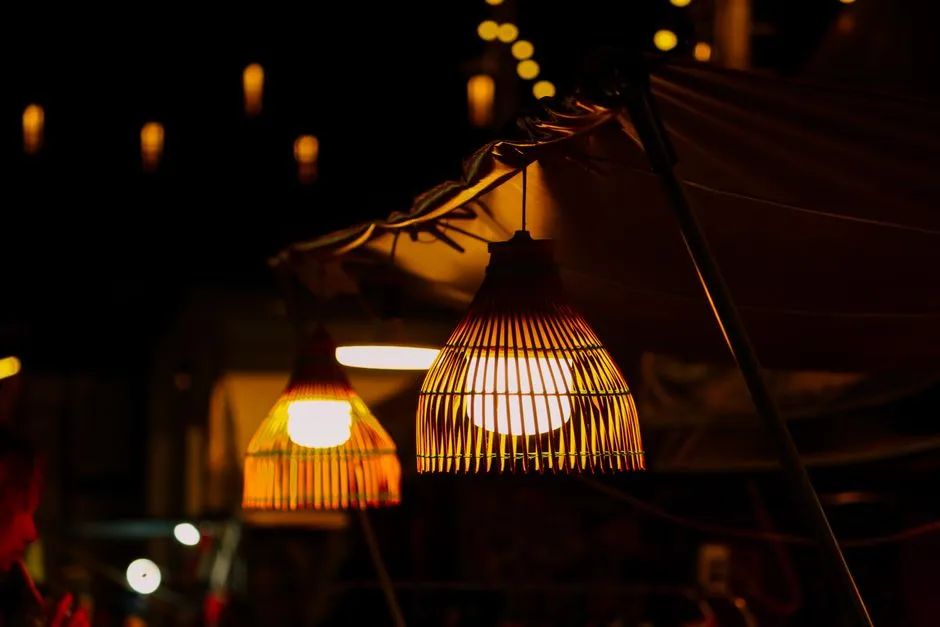
This widely stocked shape is a rounded dome that narrows toward the bulb, often woven in horizontal or diagonal strips over a wire or bamboo-rib frame.
Why it is a strong default: the dome sends and filters light in several directions, so it can work over a dining table or in an entryway without producing the aggressive shadow pattern of an open rib cage. Its familiar silhouette also reads as classic rather than tied to one brief trend.
Worth checking: cheaper versions may use thin strips glued rather than woven at the joints. Press gently on the weave when shopping in person. Online, enlarge the joint and edge photos and look for consistent spacing rather than a perfectly symmetrical glamour shot.
2. Flared basket shade, or empire shape
This shade is narrow at the top and flares to a wide bottom opening. It is usually shallower than a bell. Lighting catalogues also call the silhouette an empire shade.
A note on the older retail term: some listings still use “coolie shade.” Merriam-Webster defines “coolie hat” as a conical straw hat, while its entry for the root word labels it “usually offensive” and defines it in relation to an Asian worker hired for low or subsistence wages. The Vietnamese nón lá is a distinct cultural object; a Smithsonian Asian Pacific American Center interview describes it as a conical hat made from woven bamboo and palm leaves. Chinese dǒulì is another specific regional name. We use flared or empire basket for the lighting shape, though knowing the older term may explain otherwise puzzling retail results.
Why it is a strong pick: it is typically the least expensive well-made option in this comparison. The wide opening sends substantial light downward and outward, which can make it practical in a small kitchen or breakfast nook.
Worth checking: because the shade is shallow, the bulb is more visible from below than it is in a deep dome. A frosted or lower-glare bulb can be easier on the eyes. A warm 2200K–2700K appearance complements bamboo, but check brightness in lumens separately: the U.S. Department of Energy explains that kelvin describes color appearance, lumens describe brightness and watts describe electrical input.
3. Cylinder lantern pendant
A cylinder lantern is a straight-sided tube, usually made from strips wrapped around a cylindrical frame. Some include a fabric or paper liner for additional diffusion.
Why it is a strong pick: the narrow footprint makes it the easiest style here to hang in a tight grouping—over a narrow console, in a stairwell, or as a pair flanking a bed—without the shades touching or competing for space.
Worth checking: direct downward output is limited compared with a dome or cone because the tall sides send more light sideways through the weave. It is generally a mood-light shape rather than a task-light one.
4. Open-weave rib-cage pendant
This style uses wide-set ribs with visible gaps, sometimes crossed by a single spiral strip instead of a tight basket weave.
Why it is a strong pick: choose it when the shadow pattern is part of the design. Over a dining table or island, it creates the most dramatic light-and-shadow effect of the seven styles.
Worth checking: more light escapes upward and sideways than downward. It is therefore a weaker choice as the only light over a task surface. Pair it with under-cabinet or recessed lighting if it hangs above a working island.
5. Bamboo-rattan hybrid drum
A hybrid drum combines a bamboo frame with a rattan or cane weave, sometimes with a natural-fiber diffuser inside. Rattan and bamboo are not interchangeable names: bamboo belongs to the grass family, while Royal Botanic Gardens, Kew describes rattans as spiny climbing palms whose flexible cane is used for weaving.
Why it is a strong pick: the drum's tighter weave gives a softer, more even glow than an open bamboo style. The mixed materials can also read as furniture-grade, especially when the room already includes rattan furniture.
Worth checking: quality can vary between the bamboo frame and rattan wrap. Look for even finishing on both materials. A noticeably mismatched stain is a reason to inspect the joints and edge finishing more closely, not proof by itself that the piece is poorly made.
6. Cone or trumpet pendant
This shade is narrow at the top and wide at the bottom, like a factory-style metal pendant translated into woven bamboo.
Why it is a strong pick: the directional shape makes it the most task-friendly style here. It can work above a kitchen island or desk where you want a more concentrated downward pool of light than a globe provides.
Worth checking: the narrow neck gives the lamp less open space than a rib cage. Follow the complete fixture's listed lamp type and maximum wattage. The DOE notes that fully enclosed fixtures trap heat and that buyers should verify whether an LED is suitable for that application; a woven shade is not necessarily “fully enclosed,” but tight construction is still a reason to check the actual fixture and lamp instructions rather than assume compatibility.
7. Globe or sphere pendant
A globe is fully or nearly enclosed, with a weave tight enough for the light to read as soft and ambient rather than sharply patterned.
Why it is a strong pick: it is the gentlest and least visually busy option here, which suits a bedroom or reading nook where warmth matters more than strong ceiling shadows.
Worth checking: tight all-over weaves allow less open airflow than rib-cage styles, so the specified lamp and maximum wattage matter. A loose or lopsided weave is also more obvious on a sphere because its outline gives the eye an immediate reference.
How do you read a bamboo pendant listing?
The shopping page often matters more than the style label. Read these fields before deciding that two similar photographs describe equivalent fixtures:
| Listing field | What to verify | Why it changes the purchase |
|---|---|---|
| What is included | Shade only, cord set, canopy, plug-in kit or complete hardwired luminaire | A shade-only price may not include the electrical parts needed to hang it. |
| Material | Bamboo, rattan/cane, mixed fiber or merely a bamboo-look finish | The photograph may not reveal a mixed-material construction. |
| Dimensions | Diameter, shade height, canopy size and minimum/maximum drop | “Large” is not a measurement, and total drop affects head clearance and sightlines. |
| Lamp details | Socket/base, bulb shape, maximum wattage, lumens and dimmer compatibility | These determine fit, brightness and electrical compatibility. Do not assume a socket standard across regions. |
| Location rating | Dry, damp or wet location, stated for the complete model | In U.S. product marking, UL says only luminaires marked suitable for damp or wet locations are intended for damp locations. Other countries use their own standards. |
| Wiring and voltage | Hardwired or plug-in, supply voltage and regional certification mark | A plug format alone does not establish voltage or complete-product certification. |
| Installation documents | Mounting instructions, ceiling-support requirements and listed hardware | The light weight of bamboo does not prove that the box, hook, cord or mounting surface is suitable. |
| Returns and assembly | Whether weaving, cord length or finish variation is returnable | Natural variation can be attractive; an unusable drop length is simply the wrong fixture. |
For U.S. shopping, UL Solutions says UL Approved is not a formal designation and distinguishes a UL Listed complete product from a UL Recognized component. Elsewhere, look for the certification applicable to the country of installation. Verify the mark and exact model instead of treating a logo in a product photograph as universal approval.
What size bamboo pendant should you choose?
Bamboo pendants follow the same broad sizing logic as other woven fixtures. For one fixture lighting a whole room, add the room's length and width in feet and read the result as a starting diameter in inches. A 10×12-foot room therefore suggests roughly a 22-inch shade. Adjust down when the pendant is only an accent and up when it must carry more visual weight.
Pendants over an island or table follow a different rule: size them to the surface rather than the room. That is why island figures are often smaller than the room-dimension result, and why two apparently sensible charts can disagree. Our pendant-light sizing guide gives the full room and hanging-height framework.
If you are choosing between bamboo and its closest visual relative, the rattan pendant-light guide compares weave, light behavior and price. The distinction is worth keeping because “bamboo,” “rattan” and “cane” are frequently used loosely in retail copy.
What should you know before installation?
Many bamboo pendants are sold as a shade only. Others are complete hardwired luminaires or plug-in swag fixtures. Confirm exactly what the listing includes before buying; a shade, a cord set and a certified complete fixture are not the same product.
- Verify the support. Do not assume a ceiling box, hook, cord or anchor is suitable because a woven shade feels light. Use the fixture instructions and the rated support specified for that installation.
- Verify electrical compatibility. Match the exact socket/base, supply voltage, bulb shape, dimmer compatibility and maximum wattage stated for the complete fixture. The U.S. Fire Administration says to use bulbs that match the wattage recommended on the lamp or fixture and to keep combustible items away from lamps, fixtures and bulbs.
- Treat the wiring route as a safety decision. A hardwired pendant needs a suitable ceiling box and compliant wiring. A plug-in swag needs the installation method specified by its manufacturer; proximity to an outlet does not make an arbitrary hook or cord route safe.
- Use the stated clearances. There is no universal “few inches” rule for every bamboo shade. Follow the maker's bulb, enclosure and clearance instructions exactly.
- Match the location rating. A covered porch can still be a damp location. Use a fixture marked for the actual environment under the rules that apply where it is installed.
Hardwiring, altering a ceiling box and choosing structural fixings are jobs for a licensed electrician or other qualified trade in the relevant jurisdiction. Give them the complete fixture documentation. Do not improvise an overhead or mains-electrical installation from a shade photograph.
How do you care for a bamboo pendant?
Bamboo can hold up well indoors with simple, dry care:
- Dust regularly with a soft brush or a vacuum attachment used gently; buildup caught in the weave is what makes a shade look tired fastest.
- Keep it dry unless the complete fixture is rated otherwise. Bamboo that was not adequately dried or finished may warp, and sustained moisture can support mold on organic material. The U.S. Environmental Protection Agency says mold can grow on virtually any organic material when moisture and oxygen are present. That makes humid bathrooms and uncovered outdoor spaces poor assumptions for an indoor-rated shade. Do not infer a damp-location rating from “natural,” “outdoor style” or a covered-patio photograph.
- Use the specified bulb. Tighter globes and drums have less open airflow than rib cages, but only the maker can state the permitted lamp and wattage for a particular fixture.
- Expect some natural color shift. Untreated bamboo can mellow from pale straw toward deeper amber with light exposure. The pace is not universally “months”: finish, light, humidity and material all affect it.
A well-made pendant may serve for years, but a style category cannot promise a service life. Joinery, treatment, electrical components, environment and care all matter. When you are coordinating it with other woven pieces, the guide to styling rattan in a modern home explains how to mix natural textures without turning the room into a matching set.
Which style is the best final choice?
Match the shape to the job. A bell or dome is the safest all-round design choice; a rib cage supplies drama when other lighting handles the practical work; a cone directs more light toward a surface; and a drum or globe softens the room. A flared basket offers the lowest entry price in the rough bands above, while a cylinder fits narrow placements.
Then ignore the mood photograph for five minutes. Check weave and joinery close up, confirm dimensions, identify everything included, read the lamp and location ratings, and plan a compliant installation. That short listing audit is more useful than any claim that one bamboo pendant is “best” for every ceiling.
Sources
- U.S. Department of Energy — Consumer Guide to Energy-Efficient Lighting — explains lumens, watts, kelvin color appearance and Lighting Facts information; accessed September 4, 2026.
- U.S. Department of Energy, Federal Energy Management Program — Purchasing Energy-Efficient Light Bulbs — distinguishes lumens from watts, lists common color temperatures and warns that enclosed fixtures trap heat; accessed September 4, 2026.
- U.S. Fire Administration — Appliance and Electrical Fire Safety — says to use the fixture's recommended bulb wattage and keep combustible material away from lamps and bulbs; accessed September 4, 2026.
- U.S. Environmental Protection Agency — Why and Where Mold Grows — explains that moisture and oxygen allow mold to grow on organic material and that moisture control limits growth; accessed September 4, 2026.
- UL Solutions — Lighting Standards and Certification — explains UL Listed complete products, UL Recognized components and lighting standards; accessed September 4, 2026.
- UL Solutions — Luminaires Marking and Application Guide — defines dry, damp and wet-location luminaire markings in the United States; accessed September 4, 2026.
- Royal Botanic Gardens, Kew — The palms of New Guinea — describes rattans as spiny climbing palms and cane as a flexible weaving material; accessed September 4, 2026.
- Smithsonian National Museum of Natural History — Grass Research — places woody bamboos within its grass-family overview and describes their structural and ornamental uses; accessed September 4, 2026.
- Merriam-Webster — “coolie” and “coolie hat” — supplies the current usage label and definitions discussed in the terminology note; accessed September 4, 2026.
- Smithsonian Asian Pacific American Center — interview with Nguyễn Phan Quế Mai — identifies nón lá as a Vietnamese conical hat made from woven bamboo and palm leaves; accessed September 4, 2026.